Hey guys! Thought I’d share my shots from my 2 cameras here. Huge thanks to Stephen for the webinars, they were such help! And to everyone on here too for additional shooting tips, they were absolutely priceless (Also, I loooved Stephen’s composition on one of the webinars, so I created a very very similar one - hopefully to put on my wall hehe. Hope it’s alright!)
It was my first time shooting a solar eclipse and it was definitely stressful, especially constantly checking the weather everywhere the days before I decided to sacrifice a whole minute of totality for a clearer sky. Anyway, I’ll definitely go and see the 2026 and 2027 ones
Okay, so I’ve tried to HDR blend the corona as best as I could (about 16-18 exposures), but it’s still a little fuzzy. I’m wondering - could this be because I was not using a tracker and there is slight rotation in the corona? Even though the rotation should be minimal around noon that high up in the sky. Just wondering if anyone tried with and without a tracker. I’ve been very careful to align for all the shots for the corona rays, just wondering about rotation.
Another question: is sunset totality worth it?? Wondering about the 2026 one and whether to try and see it in Mallorca or not risk it and just go to Northern Spain Obviously I won’t get the corona, but I’ll try to get a good foreground shot.
Hi Rosie - thanks for sharing your photos, which look great!
My inner geek loves seeing the chromosphere before C3 appearing under the large 4 o’clock prominence in your shot, compared with at around 3 o’clock in mine - the difference being just due to location.
Re 2026, I’ve read some advice (can’t remember where) that viewing sites on Mallorca that look NW over the sea are rather limited. It may be very crowded and clouds on the horizon pose a higher risk. However, if it panned out, it would be spectacular, I’m sure.
I’m planning on heading to mainland Spain and trying to see the eclipse with my aunt and cousin who live in Madrid. We’ll head north from there into the path, likely towards Leon (where my aunt was born). The Sun is still low enough in the sky to plan some great wide angle shots with foreground - I just have to find the perfect view point!
Maybe others have some thoughts on the HDR alignment - I’m guessing you already selected shots that were over the shortest timespan possible? The movement of the Moon relative to the Sun can cause issues when blending, I know.
Hi,
These are great photographs. And more impressive as this was your first eclipse.
I was able to shoot with a tracker (BP) and combined 10 images of the solar eclipse all shot within seconds of each other. What I have read and found with my own recent solar eclipse shoot is that when combining images, you need to account for the moons movement relative to the sun, as well as the impact of different exposures. So when all is aligned and processed, one image of the moon is needed to cover any “ghosting” effects. This may require a very slight enlargement of the moon.
Hi. I’m also planning to shoot the eclipse from Mallorca but as you say, the viewing locations arE limited as the sun sets behind the mountains that run sharply up from the central plateau and down to the sea (the side on which the sun sets).
I’ve used TPE for many years but never for eclipses so my related question is whether it can tell me if I am in a certain location (with a known altitude) will I be able to see the eclipse peaking over the mountains or will it be obscured, or in other words can I previsualise the shadowing effect of the mountains from my shooting position?
Great images by the way so it seems that I have a lot to learn about photographing eclipses over the next year!
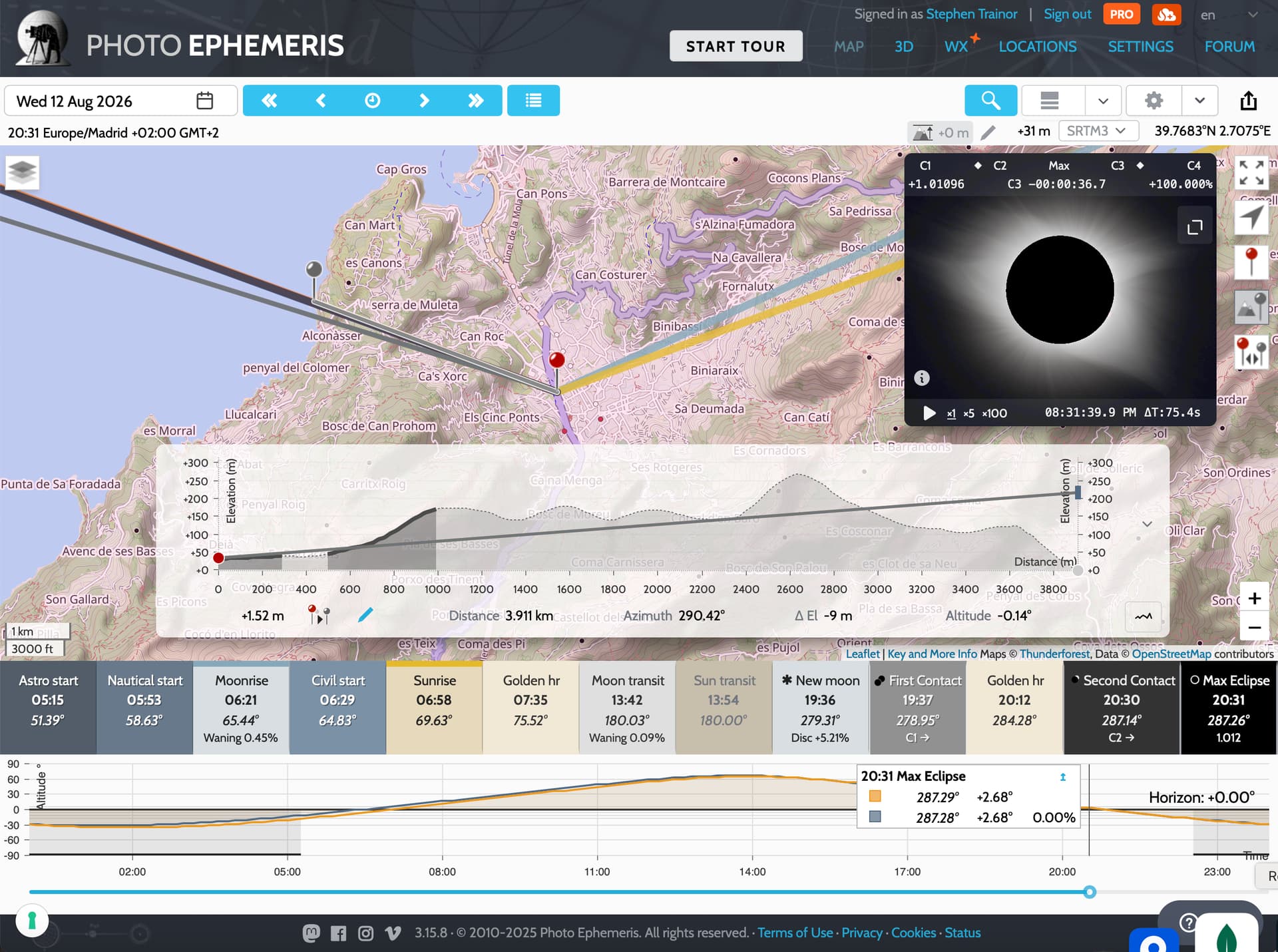
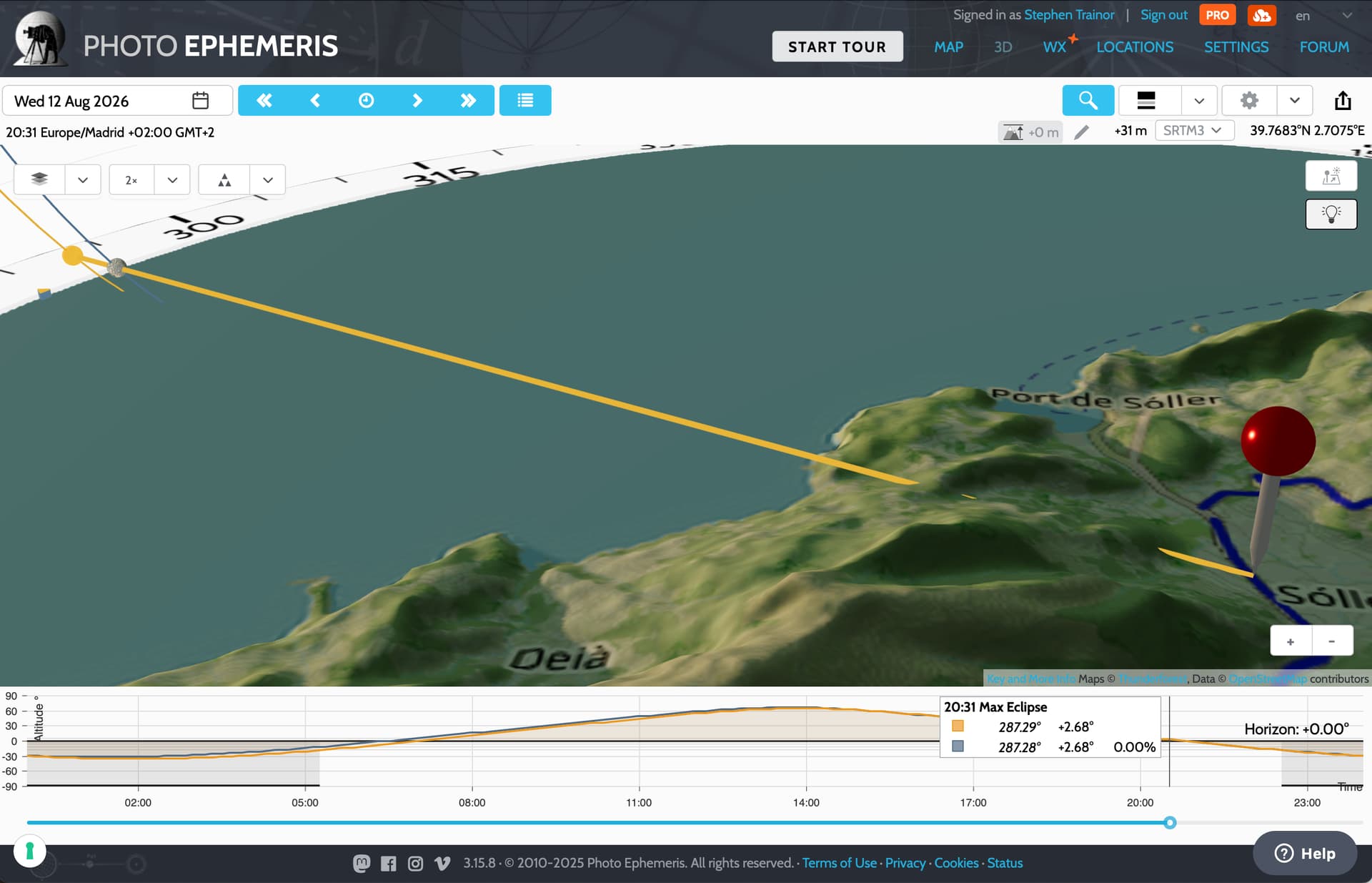
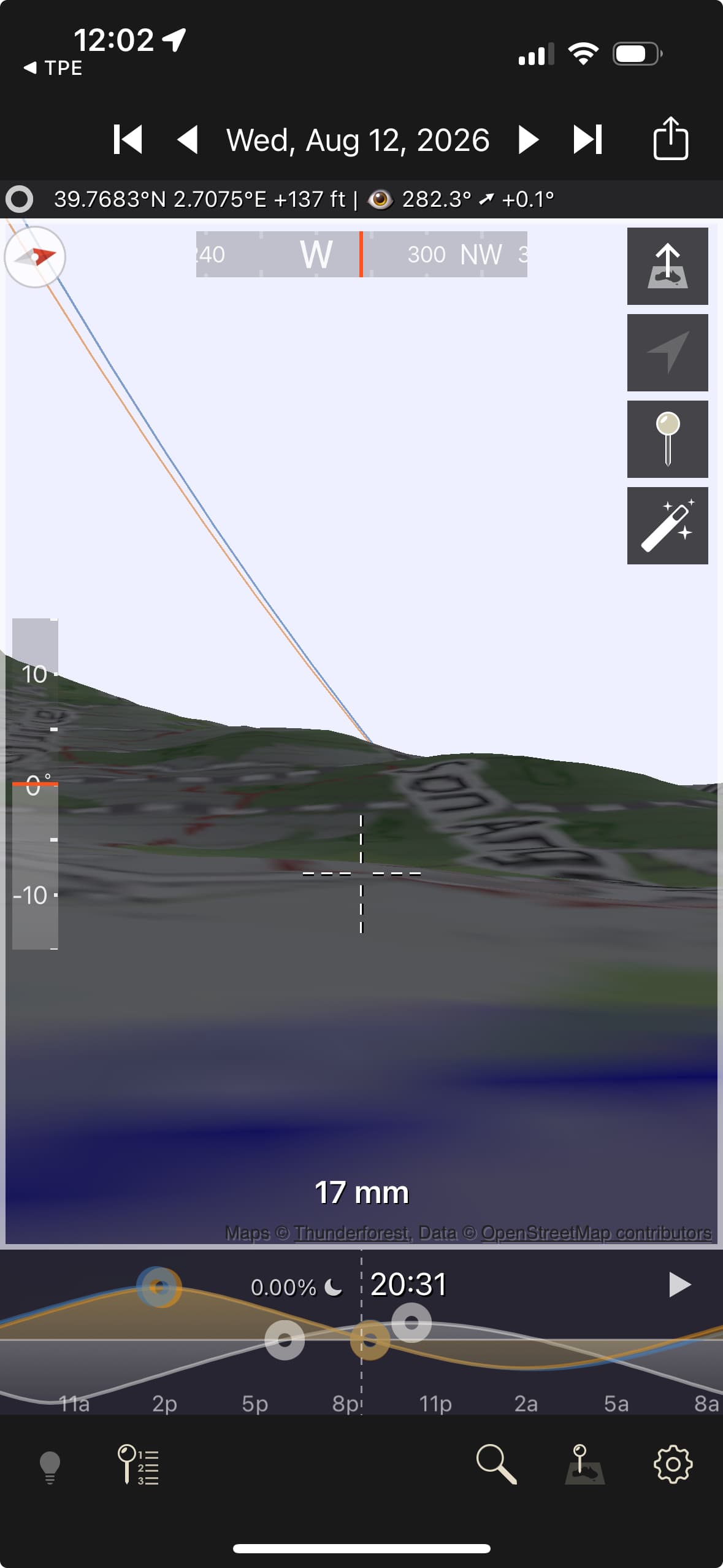
The answer is yes, you can use TPE to determine the visibility. Here are three approaches.
I picked a random spot, slightly inland from the north coast, set the time and date to max eclipse on Aug 12 2026.
Geodetics + Sightline
Using the Geodetics function, you can view a sightline by aligning the pin along the direction of the sun/moon azimuth lines. The sightline shows clearly that the sun/moon are obscured by the intervening hills from this location:
TPE for iOS also includes a similar sightline feature, if you’re on your phone or iPad.
3D View
The 3D view in the web app (Pro subscription required), also shows clearly that the sun/moon are obscured - the azimuth lines pass “through” the hillside, i.e. they’re blocked:
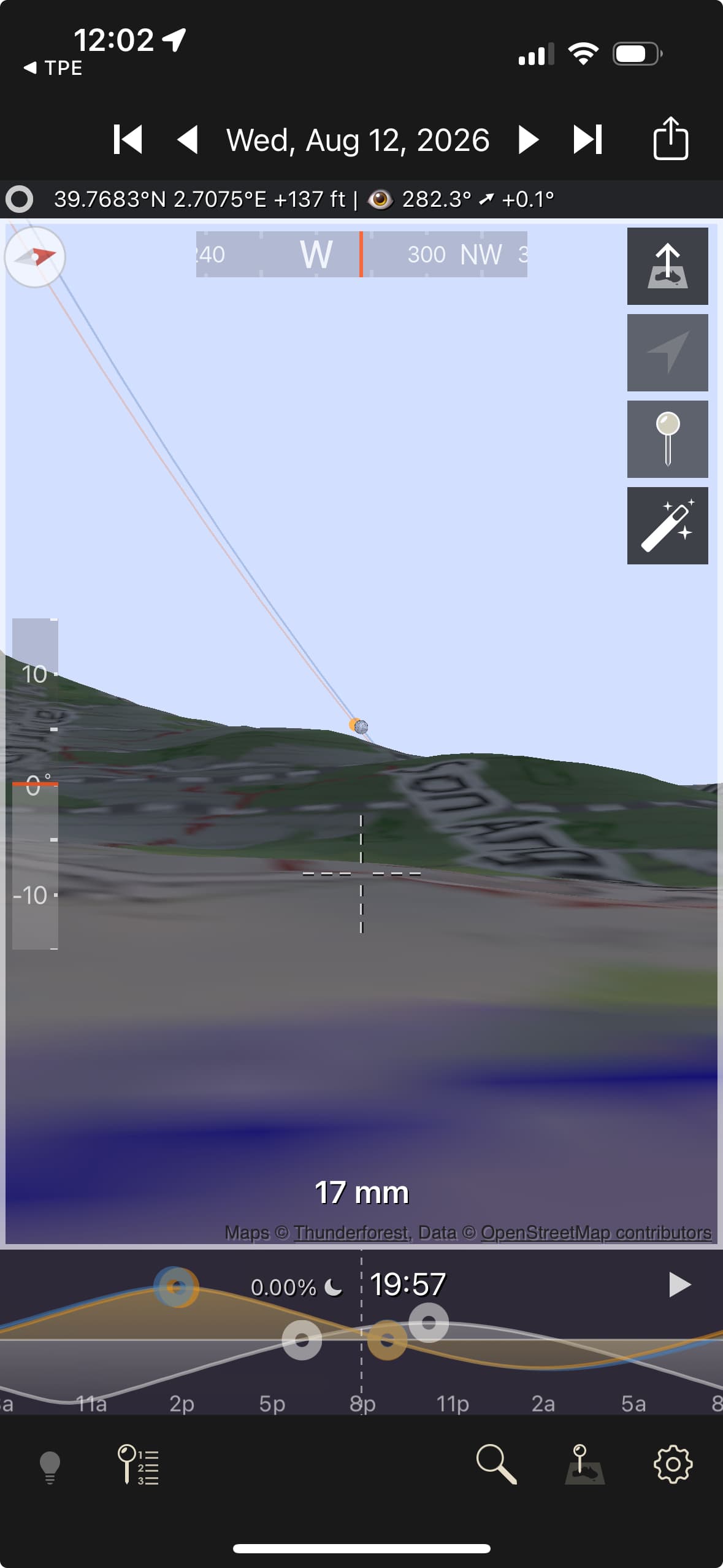
If you’re on iOS, you can check the view in TPE 3D. Drop a pin on your location and then double-click to “fly” down to the pin, then look towards the sun/moon - again, blocked:


 (Also, I loooved Stephen’s composition on one of the webinars, so I created a very very similar one - hopefully to put on my wall hehe. Hope it’s alright!)
 I decided to sacrifice a whole minute of totality for a clearer sky. Anyway, I’ll definitely go and see the 2026 and 2027 ones